Conservative Collapse and Labour’s Landslide: a data driven examination of the 2024 General Election

tl;dr

An unpopular Labour party, led by an unpopular Keir Starmer achieved a landslide victory due to the even more extreme unpopularity of the Conservatives and Rishi Sunak. But this meant that Labour’s victory was on historically low vote share and turnout.

We explore the ways in which this election is exceptional and the ways in which the result is expected given the two leaders’ approval ratings.

We conclude that this result is a lot closer to Labour’s 2005 victory than 1997 and that a competent Tory party would have a very good chance of turning things around over the next five years.

One Thousand Voters at the 2024 Election

How the British electorate voted in 2024 (per 1000 eligible voters).

The above chart shows the 2024 election result (boxes) and the major vote flows (arrows) between 2019 and 2024 (estimated using polling data).

The Conservatives haemorrhaged votes to Reform, Labour and the Lib Dems as well to non-voting. But notably, Labour lost votes compared to 2019, as incoming votes from the Conservatives were smaller than outgoing votes to the Greens, other parties and non-voting. Indeed 80% of the electorate, or 800 voters in our 1000 voter model, did not vote for Labour.

Lowest Winning Vote Share Ever

In fact, Labour won their 174 seat majority with a vote share of just 33.7% on a turnout of 59.9%. A landslide win of the order of 1997 but with:

  • The lowest vote share a majority government has ever received
  • Only a 1.6% increase on Jeremy Corbyn’s 2019 vote share
  • 500,000 fewer votes than in 2019

Labour’s result, 63% of the seats on 34% of the vote is an outlier compared to other post war election results.
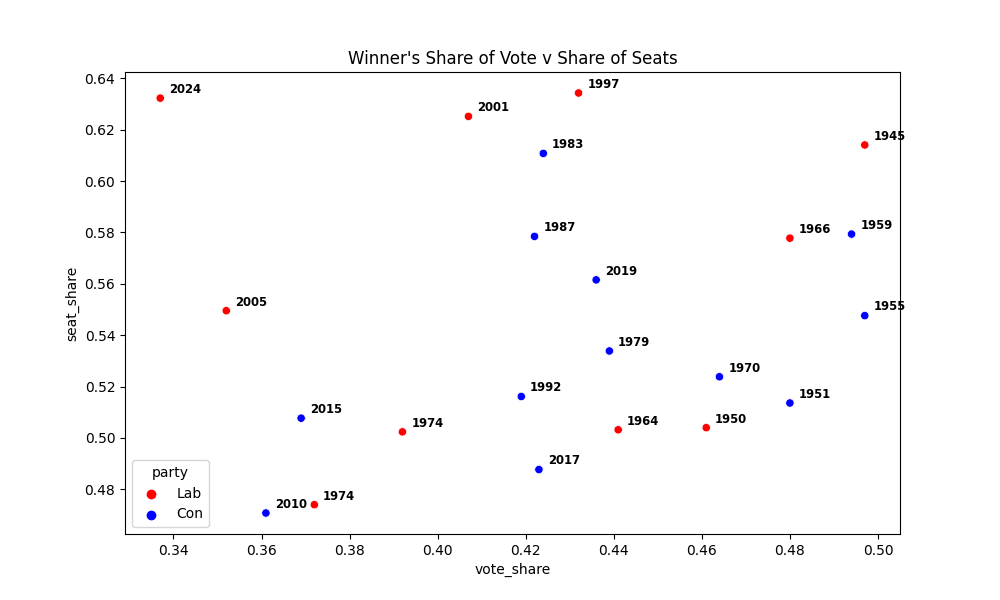
But share of the vote is not a particularly good predictor of seat share (equivalent to majority size). Excluding 2024, vote share is only 35% correlated with seat share (including 2024 this goes down to 15%).

The difference in vote share between the top two parties (how much more of the vote the winner got than the runner up) is a much better predictor of seat share (75% correlated). On this measure (Labour beating the Conservatives by 10 percentage points) the 2024 result was not atypical, and we can see that the difference was historically high.

Conservative Collapse

With an underwhelming vote share achieved by Labour, the large gap between the parties was driven by the unprecedented unpopularity of the Conservatives with only 24% of the vote.
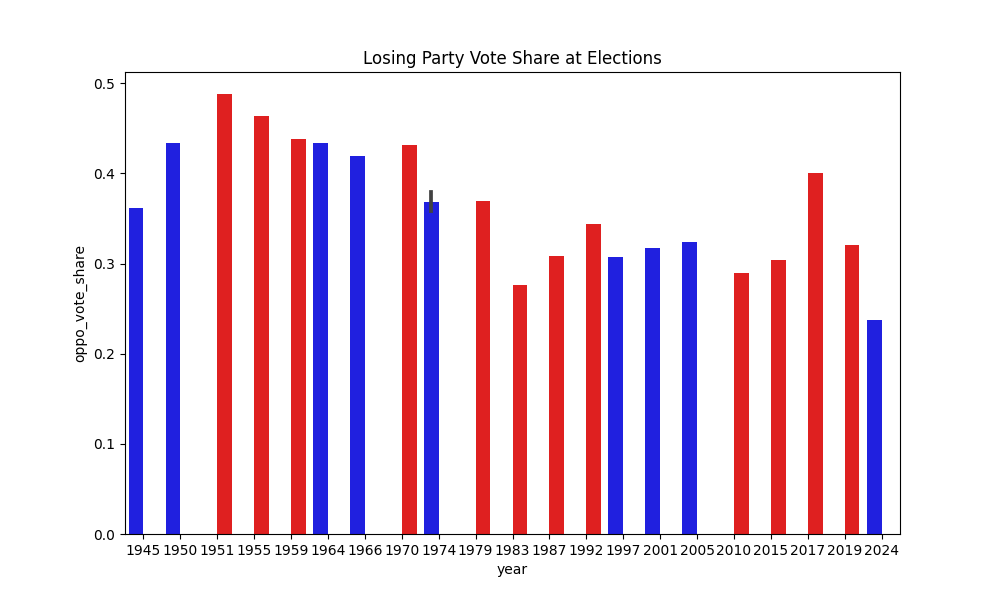
And an approval rating for Rishi Sunak of -55%.

Both historic lows. Indeed the government’s approval rating was -71%.

Starmer – the least unpopular option

So with a historically unpopular Conservative party, why did Labour not get more votes? Approval ratings of party leaders are highly correlated with party vote share (70%).
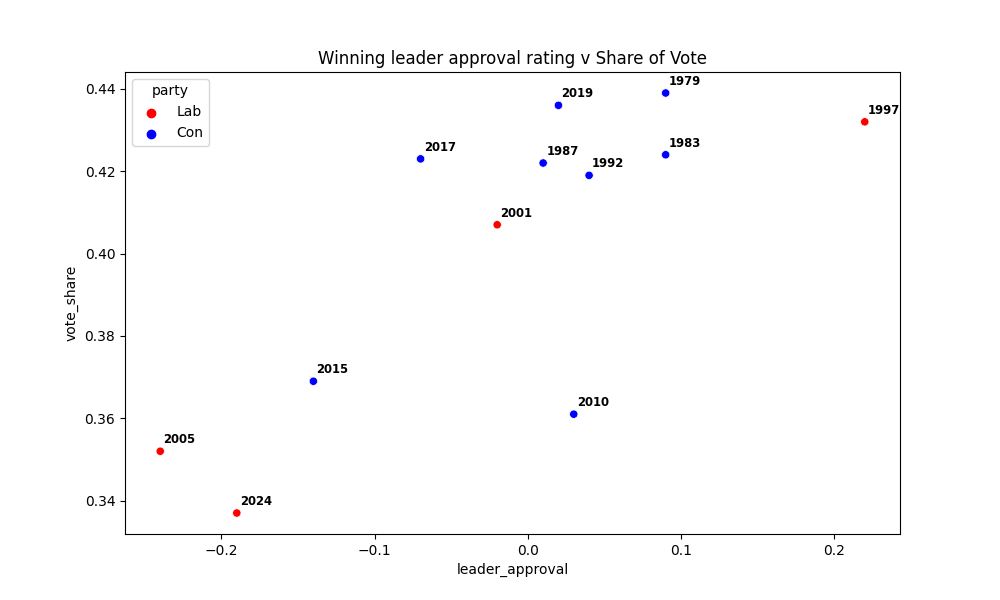
Starmer’s approval rating of -19% was the second lowest for an incoming prime minister from Ipsos Mori’s leader approval ratings. Second only to post-Iraq Blair.

In fact, in YouGov’s politician popularity tracker, Starmer comes in at 24th, between John Prescott and William Hague and with the same popularity score (22%) as Jeremy Corbyn. He is less popular than Tony Blair (23%), Theresa May (23%), Angela Rayner (25%) and many more.

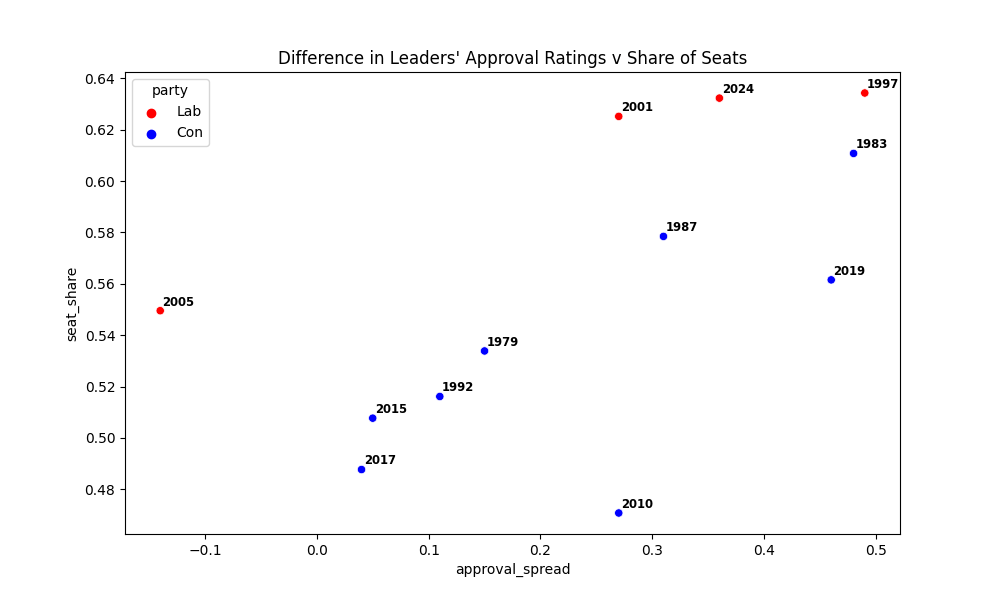
But when comapred to Sunak’s approval rating (-55%), it gives Starmer a relative lead of 36%, which is comparatively high. Somewhere between Labour in 1997 and 2001, two other landslides.
Indeed, in a YouGov poll asking why people were voting Labour only 28% of the respondents responded in a way that indicated support of the Labour Party or their policies:

  • 5% – I agree with their policies
  • 4% – To support the NHS
  • 2% – For a fairer society

Compared to 69% indicating that they wanted to get rid of another party:

  • 48% – To get the Tories out
  • 13% – The country needs a change
  • 4% – They are the best alternative with a chance of winning

Hardly a ringing endorsement of Labour and their policy agenda.

Turnout

Turnout was very low at 60%. This low turnout may be driven by the unpopularity of the party leaders.
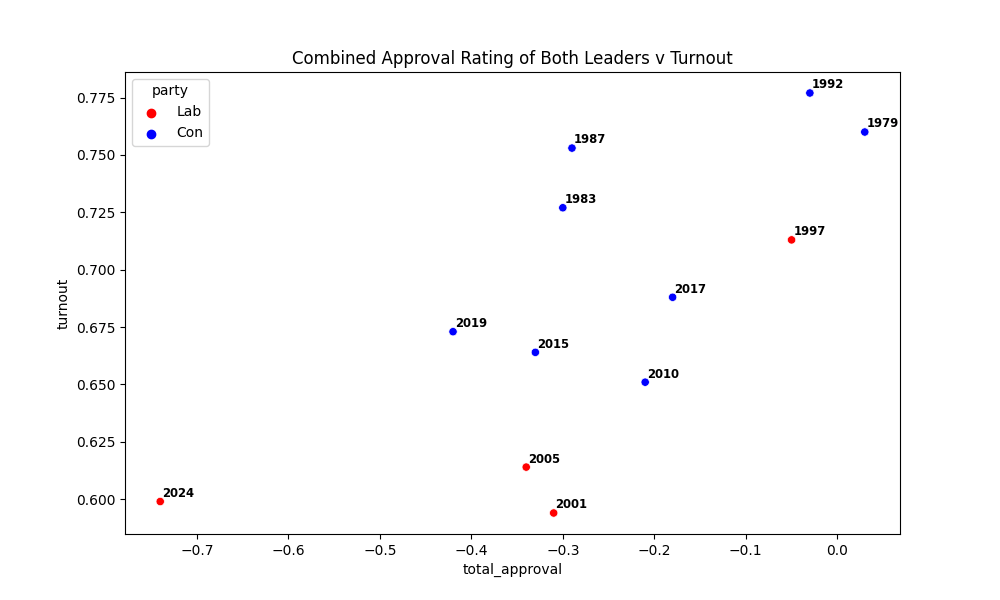
The data reveals a strong relationship between the popularity of the two major party leaders and turnout. The sum of the two party leaders net approval ratings is 62% correlated with turnout.

The sheer unpopularity of the two leaders is a clear historical outlier.

Why were the Conservatives so Unpopular

On to speculation. There are many reasons why the Conservatives are unpopular including well documented scandals. Rather than re-hashing these I will zero in on a few more structural things.

  1. They haven’t achieved anything – since the early days of Cameron there is little that the Tories can point at and say, this is what we’ve done
  2. Constant Infighting – 5 different prime ministers and a number of leadership contests while in power takes its toll. People do not want to vote for a party that is so divided and whose MPs are so obviously concerned with self-advancement
  3. Covid – a crisis of the scale of Covid has had a real impact on living standards. It also requires a lot of high stakes decisions to be made, some of these were mistakes at the time, some were mistakes in hindsight. In general however, the government will get judged asymmetrically with a failures weighted much more highly than successes

It would be tempting for a Conservative politician to blame Reform ‘splitting the vote’ for their defeat, but this would be an error. Their loss and Reform’s success was driven by the Conservative’s unpopularity. The vote was only split because people couldn’t bring themselves to vote for a divided party who has achieved little and been mired in scandal.

Therefore the Conservatives must resist the urge to lurch to the right to try and compete with Reform. A competent centre right party with a competent leader, untainted by the prior scandals and a sensible set of policies will do very well in five years time.

This is not 1997

Despite the landslide victory and the size of the majority this is not 1997. Labour, led by Starmer, is coming into power untainted by office but already unpopular. They also inherit a tight budget, struggling public services and an ever increasing pensions and NHS bill that will make the next 5 years very tricky.

From the data, this looks much more like Labour in 2005 than 1997 with the unknown being whether the Tories will successfully rehabilitate their image in opposition.

A New Taxation Paradigm

tl;dr

We argue that no taxes should exist simply to raise funds, all taxes should be aligned with public policy objectives. This leads to a proposal where the majority of funds are raised through a Land Value Tax, a Carbon Tax, a Consumption Tax and Sin taxes.

Two Birds with One Stone

Each tax has two primary effects:

  1. Raising funds for the exchequer
  2. Changing behaviour

For example, fuel tax raises a certain amount of money but also reduces the amount that people drive by increasing the cost of doing so.

For some taxes, changing behaviour is a primary objective (for example cigarette duty) but for many the behavioural impact runs counter to our policy objectives. Income Tax, for example, has many negative impacts on the market. These taxes exist because of inertia (each government largely raises tax in the same way as its predecessor) and because they historically were easy to administer (Income Tax was first successful when the collection was outsourced to companies and the worker never saw the pay) but they need not.

Thinking about it from first principles, why not think of a set of behaviours you wish to discourage and raise all of your funds taxing them?

Bad Things

  • Emitting CO2 (and other greenhouse gasses)
  • Grossly disproportionate distribution of essentials
  • Consuming things that kill us

Carbon Tax

Greenhouse gas emissions are a classic market failure – those doing the emitting pass on the costs (global warming etc) to everyone else to deal with. The solution from classical economics is to tax the emitters to bring the cost of emitting in line with the cost to society. The complication is taxing imported emissions (the carbon used to make imported Chinese steel), but this does not seem insurmountable. Default import taxes can be set at sensible levels, with companies able to provide documentary evidence of their emissions to reduce their liability.

This tax would nudge the U.K. towards greener sources of energy whilst raising substantial funds for the exchequer.

Land Value Tax

Society should ensure that everyone has access to at least a base level of the essentials needed for life – shelter, warmth and food. Additionally, it is important that society provides people with the opportunity to have their own space – to start a family, move for new opportunities or to take responsibility for themselves.

Currently, we as a society are failing in this obligation. It is too expensive for young people and those on lower incomes to access the space they require, in part, due to the extreme inequitable distribution of land.

By taxing the value of land, a force is created in the tax system to penalise under-utilisation of our existing housing stock (eg. second home owners or a couple living in 5 bed home) and land.

This tax has a nice intuition behind it. It can be thought of as a ground rent to the government for securing the land militarily and protecting your property rights via maintaining society and rule of law. Those with the most land to protect pay the most.

Sin Taxes

Cigarettes, alcohol, sugar and fizzy drinks, and at some point perhaps recreational drugs are all goods that damage the health of the consumer and put a burden on the health services and society. We should therefore maintain taxes on these goods to raise funds for the exchequer whilst reducing their use.

People tend to complain about the Nanny State with regards to Sin Taxes. But surely it makes more sense to tax your consumption of sugar and in doing so raise funds rather than taxing your purchase of running shoes (via VAT) and spending that money on an expensive public health campaign to discourage sugar consumption.

The Impact on the Economy

Recall that these taxes will replace all existing forms of taxation including all income taxes, inheritance tax (land is now taxed continuously), VAT and stamp duty.

In the long run, a new equilibrium will be formed where:

  • Take home income will be higher
  • House prices will be lower and the cost of continuing to own property higher
  • Energy intensive goods will be more expensive
  • The transition to non carbon energy sources will be accelerated

Transition

Implementation must be gradual, tapering up the new taxes and down the existing taxes over a five year period to allow the economy time to adjust.

House prices are the major implementation difficulty. They are undoubtedly too high, however plunging recent buyers into negative equity defeats the object of trying to help those who are struggling to afford their own space. Implementing at a time of moderate to high inflation (ie now) may help soften the blow, but some targeted help may be necessary to for those who have recently bought houses.

Political Labels, Bayesian Priors and Centrism

tl;dr

The public policy idea space is too large for most individuals to reach an informed view on all issues. Individuals therefore use some high level model (belief in the market, state control, libertarianism etc.) to define a prior or starting point. We identify models associated with political and economic schools, parties and finally define centrism as the political prior associated with trust in institutions and the status quo.

Homo Economicus

In economics, there is the concept of homo economicus – a purely rational actor which weighs all available information to make an informed and optimal decision. Behavioural economics has largely shown this to not exist in the real world where individuals regularly fall into logical heffalump traps and behave irrationally.

In politics, we have an analogous view that people should weigh the evidence on both sides of a debate and come to a rational decision. However, the complexity of many issues, the number of issues and the lack of complete information make this impossible to do.

Bayesian Thinking

In mathematics, Bayes Theorem describes how we should integrate a new observation into our view of the world. Interestingly, it requires a prior view of the state of the system to do so.

One analogy for this is the Warmer/Colder modification to a treasure hunt. With something hidden from a child, you periodically tell them as they move around whether they are getting warmer (closer to the target) or colder (further away). With repeated nudges they slowly zero in on the treasure.

After many observations we should arrive at the ‘correct’ result. But in real life, in the public policy space, observations are rare and uncertain so it matters a lot where we get our starting point from. After only three warmer/colder hints, we will probably be closer to the target than where we started, but we may still be a long way away.

Anchors and Generalisation

Given how important that starting point is, how we arrive at it is an interesting question.

A logical approach would be to train a more generalised model on all the observations available and use that to generate your prior for any particular policy. For example, you might look the history of rent controls and food price controls to build a prior on the suggested policy of energy price caps (from where you can begin the process of updating based on data). Or you might use a yet more general model, something along the lines of ‘generally markets work better than government intervention’ as your starting point (thus requiring a higher level of evidence for a policy that increases government involvement).

But we don’t always have to build our own model. Other people spend a lot of time thinking about this stuff, so a perfectly valid way of generating priors may be to use the views of people or institutions that we trust, for example political parties or influential thinkers. We can then diverge from these views using our own observations, but it gives a good starting point.

Below we detail some possible mental models that may generate priors for some people.

General Policy Models

  • Ideologies – Communism, Anarchism, Libertarianism etc.
  • Political Parties – Conservatives, Labour, Greens etc.
  • Party Factions – Momentum, ERG
  • Media Outlets – The Times, The Guardian, The Daily Mail, The Mirror etc.
  • Individuals – The popular Twitter account, blogger, vlogger etc.
  • Religions or Religious Leaders

Each of these models can change in importance over time as people evaluate whether they generate useful priors.

Centrism

How then does a centrist think about generating priors. There are some options for how we should think of centrism:

  1. Centrism is the limit of incorporating all available observations – it is the point where those with left wing and right wing priors will eventually end up if they accurately account for all the real world data out there
  2. Centrism is a high level of pragmatism, realising that generally what is achievable will be somewhere between the views of the major political parties
  3. Centrism is defined by a high degree of trust in institutions. It therefore assumes that the set of policies created by those institutions (and existing today) is a good prior for evaluating the correct policy

Option 1 (Optimal Centrism) seems to be disproved by the fact that centrist policies are highly localised. For example the U.K. centrist views on Gun Control (no guns please) and Healthcare (more NHS funding) are very different from the US centrist view on Gun Control (background checks) and Healthcare (more help for people who can’t afford insurance). Even if I have mischaracterised the views slightly, it is clear that the gulf is wide and therefore it seems unlikely that both these positions were achieved by correctly integrating all available information.

Option 2 (Pragmatic Centrism) seems somewhat unsatisfactory as an explanation for how centrists locate a policy position through priors and observations. It describes the reduction of the idea space to a set of achievable policies rather than telling us anything about how the optimal policy might be selected.

Option 3 (Institutional Centrism) seems the most persuasive option. ‘Many intelligent people have spent a good deal of time creating and refining the current system’ appears a perfectly defensible position and it predicts that a reasonable prior for most policies is the current position. From there we can tinker, adjusting policies slightly, adding or removing small sections of regulation, reallocating spending and taxation to a certain extent and creating new institutions and bodies to help further optimise the machine.

We may want to think of centrism therefore as not only existing on the left-right spectrum between the two main parties, but also as existing on a separate spectrum of institutional trust, with centrism standing opposite radicalism.

Brexit and Campaigning

The Brexit vote was one for which there were very few reliable observations to update your position with. This framework would therefore suggest that priors will have a high relative importance in the final vote.

As it happened, Centrists were generally in favour of remain as the status-quo and pro-institution option. Both sides made lots of (with hindsight) incorrect predictions about what Brexit might entail, predictions that were generally ignored. Vote Leave ended up winning the vote by persuading the public that not surrendering sovereignty should be the correct starting point for the debate (Take Back Control).

Tax System Bugs Part 1 – Plumbers and Plasterers

tl;dr

Income Tax is a friction that prevents many beneficial but marginal transactions from taking place, particularly in labour heavy industries. A re-designed tax system would avoid income tax.

Benefits of Specialisation

A plumber and a plasterer are doing up their homes. Both houses have a similar amount of work to do, a week of plumbing and a week of plastering – a specialist however, could get each job done in three days. They could do all of their own work in eight days (three days doing the job they excel at and five doing the job they are less skilled at) or, if they are good friends they could swap houses – one do all the plumbing and the other all the plastering and they’d be done in six. Economic specialisation in action, saving each 25% of their time.

This example is a bit like a barter system. It relied on the plumber and the plasterer having something the other wanted at the same time – an unlikely event. In modern society we have solved the barter issue using money – now the plasterer and plumber don’t have to be doing home improvements at the same time. Say they charge a day rate of £200 – the plumber could pay the plasterer £600 to do work in his house in May and the plasterer could pay the plumber £600 in July. They result is cash neutral and allows both to get the job done in six days.

This also means that the two are no longer tightly coupled, the plumber could employ and be employed by two different plasterers and still the maths would work out. 6 days of work, economic benefits for all!

Except, we interfere with this nicely functioning market with taxes.

The Tradesman’s Swap Bug

In reality our tradesmen pay tax and charge VAT. Of the £600 for three days work, £190 is taken in Tax and NI and £410 goes to the individual. VAT is additionally charged at 20%, so instead of invoicing £600, you invoice £720.

Looking back at the sums our plasterer now:

  • Spends £720 on plumbing work
  • Gets £410 from plastering work
  • Gets two days back in productivity for spending £310 in cash
  • By putting those days to work plastering will only make £270 (post tax)
  • Is £40 worse off

Therefore this trade doesn’t happen. Both workmen do the whole job themselves, taking 8 days and not reaping the benefit of specialisation.

By taxing labour too heavily we have made the economy less productive in a very real sense.

Childcare

This may seem like a niche example. But the implication is that this is happening all over the economy. One particularly clear example is that of childcare.

A household can look after it’s own children or employ childcare to do so (in the form of a nursery or childminder). To make this decision economically viable, it stands to reason that the person returning to work should make more than the cost of the childcare. However, similar to the above example, tax enters the equation and the amount that must be earned increases by the earners marginal tax rate. This means that many parents who (absent tax) could return to work are unable to do so.

Childcare Vouchers

A poor solution to this issue (from the perspective of the market, it may be desirable from the perspective of the child) would be the issuing of childcare vouchers that entitle everyone to a set number of hours of free childcare a week.

  • For high earners already willing to pay for childcare it acts a pure windfall
  • For middle earners it may in some cases compensate for the tax issue and allow some parents who want to to go back to work
  • For low earners it encourages irrational transactions (where the parent may make less than the childcare costs absent of the voucher)

In all it is an expensive policy that doesn’t help a huge amount from the perspective of ‘getting parents back to work’.

Repeal Income Tax

The solution to this problem? Move the tax burden away from income. Reduce, or ideally repeal, taxes on earned income such as Income Tax and National Insurance.

Policy Debt, Taxes and Digging Holes

tl;dr

Technical Debt is a concept from software development describing how, over time, pressure to deliver features leads to complex systems and low productivity. A parallel concept, Policy Debt, can be observed in the public policy sphere, particularly in the hugely complex Tax Code. As in software development, although the optimal solution may be to slowly re-factor and simplify, the only solution that can be sold to stakeholders is a complete rebuild of the system.

Tech Debt

In software development there is the concept of technical debt (tech debt). When a new feature is needed often the only option is to cut corners to get it released on time.

Maybe you save time by avoiding changing existing code, preferring to bolt on additional logic. This might be fast (it reduces the risk of breaking existing functionality) but it creates issues for the future as your system becomes more complex and logic is duplicated.

Alternatively, strapped for time you may write some bad code. You probably know it’s bad, but you don’t have time to write anything better.

Over time this bad code and complexity (plus many other tech debt issues) accumulate making:

  • Unexpected things happen in your system (bugs)
  • Your developers massively unproductive (and their life a misery)

At some point this ‘debt’ must be paid or the system slowly grinds to a halt.

If you’re not familiar with software development, consider the shared spreadsheet at work. The one with 27 tabs and whole sections that you simply wouldn’t dream of touching lest you upset the Excel Gods. That’s tech debt.

Policy Debt

Public policy is similar. Every government begins, not from a blank slate, but with a portfolio of laws, policies and taxes that it inherited. The costs of changing any one of these are huge – there are sections of the population who benefit from each of them, business interests who rely on them and a limited amount of time to get things done. Therefore the easiest thing to do to achieve policy aims is to overlay additional laws, policies, taxes and rebates onto what already exists.

We’ll call this policy debt. It is particularly pernicious in the tax sphere for a couple of reasons:

  • The system of allowances, thresholds, rates, exemptions and relief give many more dimensions over which to increase complexity
  • Any change to the tax code impacts people directly and measurably in hard currency. This makes the political fallout stronger and the cost of change higher

So, does the U.K. tax code represent policy debt? Here is a list of some current taxes:

  • Income Taxes
    • Income Tax
    • National Insurance (Employer and Employee)
    • Health and Social Care Levy
    • Capital Gains Tax
    • Inheritance Tax
  • Property Taxes
    • Council Tax
    • Stamp Duty
    • Car Tax
  • Business Taxes
    • Corporation Tax
    • Business Rates
  • Consumption Taxes
    • Value Added Tax
    • Fuel Tax
    • Air Passenger Duty
    • Various ‘Sin’ taxes

As well as many niche taxes such as Insurance Premium Tax. Now this may not seem like too much until you consider how complex each of these can become.

Focussing purely on income. Income Tax has a tax free personal allowance, a 20% basic rate, a 40% higher rate, a 45% additional rate. Your personal allowance reduces to 0 above a certain threshold and there are individual allowances for dividends, savings interest, self employment income, property rental and under certain circumstances marriage. Also ISAs, LISAs and Pensions ‘protect’ income from being taxed. National Insurance has different allowances and rates that kick in at different levels. Plus there is the Health and Social Care Levy which is like National Insurance but different in a presumably very important way.

To add additional complexity, individuals and companies are taxed differently on income (50+% v 20%) which creates a whole class of loopholes (or tax code ‘bugs’) where you can reduce your tax bill by routing your income through a company and drip feeding yourself the cash through salary, dividends and loans, but only if you have sufficient knowledge of the system or can afford an accountant.

As a function to decide how much tax someone pays based on their income, this certainly feels overly complex to me.

As a system weighed down by tech debt requires more and more developers. So too, the complexity of the tax system and the ability to reduce one’s bill through loopholes creates a whole industry of tax accountants and advisors.

Digging Holes

The economy allocates labour (and scarce resources) to fulfil desires under a set of rules dictated by the government. We can look at the jobs that are created and examine the value that they add to get insight into that rule set.

Tax advisory annual industry revenue in the U.K. is estimated to represent £4.7bn pa. https://www.ibisworld.com/united-kingdom/market-research-reports/tax-consultants-industry/

Making some assumptions about average salaries, we can estimate that this represents 50k-100k full time workers before we even consider the time spent by regular accountants on this kind of activity.

That is possibly more than 100,000 U.K. workers, presumably intelligent and skilled, making up an industry that achieves what? Most charitably it ensures that the correct amount of tax is being paid, less charitably it minimises the amount of tax that can be collected from its clients for use on public services. Why does an economy need such a large group of people working with such aims? From a planning perspective, that time would be better spent digging holes. (No offence to any tax accountants out there – they didn’t create the rules). When the invisible hand is allocating a workforce equivalent to 20% of the teachers in the country to something utterly pointless (and that clearly wouldn’t exist without the government) it’s likely that something in the ruleset is wrong.

A largely pointless tax advisory function, frequent tax evasion scandals and the constant need to close loopholes whack-a-mole style all point to huge policy debt in the tax sphere. The key question then is how to fix it?

Lessons From Software Development

It is hard to get a piece of work approved to fix a small amount to tech debt. For example, it is difficult to get approval to spend a couple of days making the shared spreadsheet marginally less bad. Similarly, it is tricky to sell a couple of weeks work to make some horrible code slightly less horrible. The problem is the same in politics.

Why has no one tackled turning the various taxes on income into a single Income Tax? It would be a perfectly sensible thing to do. The reason that it’s not done is that some people would inevitably lose out, they would complain and you would end up expending political capital to force through a very sensible change with small but largely invisible benefits – politically, it’s not going to win you votes.

So how is this problem solved in software development? When you can’t sell incremental improvement, eventually a total rebuild is required. Delete the old spreadsheet and make a new one without any of the issues of the old one, tear down swathes of code and replace them with something new, efficient, probably in a cool new language.

People cannot stand investing time to change something only for it to remain basically the same steaming pile of excrement as before, even if the pile is marginally less worse. But they will buy into making something new and great.

So how to deal with policy debt in the tax code. Burn it to the ground. Complete and utter destruction of the old rule book and the creation of a shiny new one. Simpler and better. Raising more money, more fairly, for less impact on the economy etc.

In Summary

  • Policy debt is like tech debt for politicians
  • It slowly makes our tax system dysfunctional
  • It is politically impossible to slowly unravel the chaos
  • The solution is a complete rebuild